Where the money goes when a player loses $100 on an Illinois VGT
A player walks into a corner cafe, sits at a video gaming terminal, drops $100 into the bill validator, and walks out an hour later with $0. That $100 doesn't go into the cafe owner's pocket. It fans out across four parties before any of it ends up in the establishment's bank account. Here's exactly how the math works.
Step 1 — The machine pays out winnings first
Illinois VGTs are required to return roughly 92% of money played as winnings, averaged over time. That payout rate is set by the state regulator; the variance from machine to machine is small.
So before anyone splits anything, a meaningful slice of the $100 goes back to players as ticket vouchers. Players cash some out, lose some back the same session, and the math averages over the month.
The number that actually gets divided is what's left after winnings — Net Terminal Income, or NTI. On any single session NTI can be anywhere from negative to all of it; over a month and across players, it lands close to the long-run house edge.
For a single player who walks in and loses $100 with no winnings cashed out — a clean illustration — the full $100 IS the NTI. Easy math. Now we split it.
Step 2 — The state takes the largest single slice
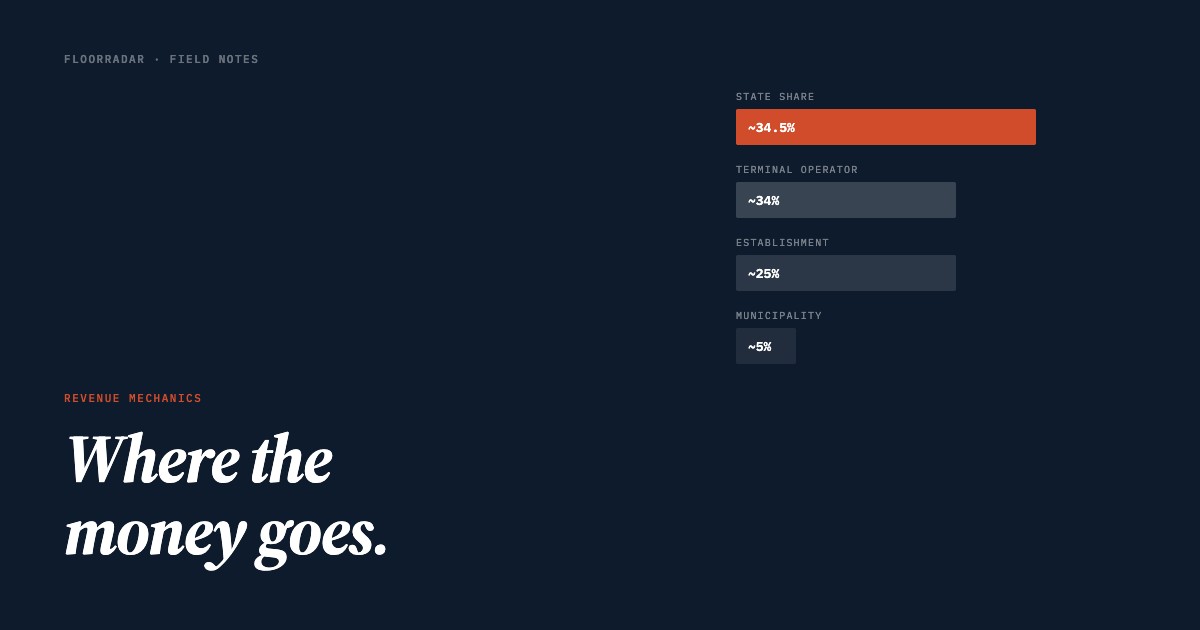
Illinois levies a graduated tax on each establishment's monthly NTI. The exact tier depends on how much the establishment generated that month — bigger venues hit higher tiers — but the effective rate runs roughly 33–35% across most operators. Call it $33–$35 off the top.
That tax is split between two state-administered funds. The biggest portion goes to the General Revenue Fund. A smaller portion goes to capital projects and education. The state regulator itself takes a 0.92% administrative fee out of the state share.
The graduated structure matters: operators who push from one tier into the next see meaningfully lower take-home on each marginal dollar. If you're sitting just above a tier boundary, every additional $1,000 of NTI is worth less to you than the prior $1,000.
Step 3 — The municipality takes a smaller cut
The city or village where the establishment sits gets 5% of NTI, automatically. From our $100, that's $5. This is non-negotiable; it's set by state law, not local ordinance.
This is also why local political dynamics around VGT can get heated — that 5% can be meaningful to small municipalities. A village with 20 establishments grossing $30K NTI/month each is collecting $30K/month directly from gaming. Some communities ban VGT entirely; some allow but cap; most allow.
Step 4 — The Terminal Operator takes their share
This is where most operators new to the industry get tripped up. You don't own the machines. Illinois law requires a licensed Terminal Operator (TO) to own and place the machines in your establishment. There are about 80 licensed TOs in Illinois; the largest few control most of the market.
The TO and the establishment split the post-tax NTI 50/50. After state ($35) and municipality ($5) take their cut, $60 is left. The TO and establishment each get $30.
The 50/50 split is set by state law and isn't negotiable in either direction. What IS negotiable is which TO you pick, what services they bundle (signage, marketing, management software), and how aggressively they support your floor.
Step 5 — What the establishment actually keeps
Out of $100 lost by the player, the establishment owner walks away with $30 of gross gaming revenue. Before paying any of their own bills.
Out of that $30, the establishment owner still has to cover:
- Lease or mortgage on the physical space
- Labor — bartender, server, manager
- Liquor license annual fees
- Utilities, insurance, security
- Cleaning, maintenance, replacement glassware
If the cafe is gaming-only — no food and beverage revenue — that $30 has to cover everything. Most cafes run lean enough on operating costs that they're profitable, but the margin is thinner than people assume.
If the venue has meaningful food and beverage revenue (a real bar, a real restaurant), the gaming $30 is supplementing already-profitable hospitality. Those venues have the most resilient economics.
The summary table — $100 lost, who got what
| Party | From $100 NTI | % of NTI |
|---|---|---|
| State of Illinois (graduated tax) | ~$35 | ~35% |
| Municipality | $5 | 5% |
| Terminal Operator | $30 | 30% |
| Establishment owner | $30 | 30% |
Why this matters when you're thinking about acquisition or expansion
If you're looking at a venue and the state market report shows it produces $40K NTI per month, your back-of-the-envelope is $12K of monthly gross gaming revenue to the establishment — about $144K annualized. That has to cover the establishment's operating costs PLUS leave any profit for the owner.
Established cafes with low overhead can run on that. Restaurants and bars need food and beverage to bridge the gap. New ground-up locations need to clear well above $40K NTI to make the math work — you're paying full lease, full labor, full launch costs while building toward steady-state revenue.
NTI is the foundation. The 30% take-home math is the lens you read it through. Together they tell you which venues are healthy, which are coasting, and which are slowly bleeding to break-even or below.
FloorRadar overlays the take-home math automatically — for your venue and every competitor in your market. The dashboard surfaces what each venue actually pocketed, not just the headline NTI.