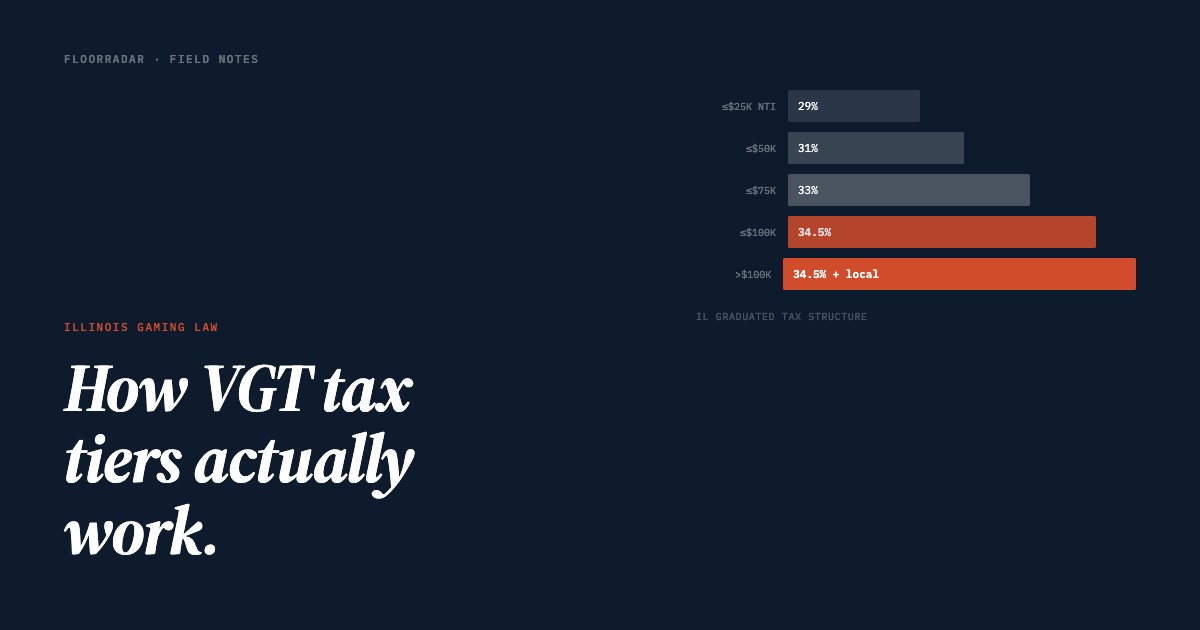
How Illinois VGT graduated tax tiers actually work
If you operate a Video Gaming Terminal in Illinois, you've heard "the state takes about 35%." That number is a useful approximation, and it's also wrong in a way that matters. The state's share is calculated on a graduated curve — the rate changes as your monthly Net Terminal Income climbs. Knowing where your venue sits on that curve changes what every additional dollar of NTI is actually worth to you.
The basic split
Every dollar of NTI generated by a VGT in Illinois gets divided four ways, in this order:
- State of Illinois: graduated rate (we'll get to the curve below)
- Municipality: 5% of NTI (or 0% in non-home-rule cases — varies)
- Terminal Operator: ~5% of NTI (the company that owns the machines and services them)
- Establishment owner (you): the remainder
The math people remember is the after-state, after-muni, after-TO baseline: roughly 0.35 of NTI to your pocket. That's a real number — but it's the average across the state-share curve, not the marginal rate at your specific monthly NTI.
Why it's graduated, not flat
The state's share of NTI moves in steps based on monthly volume. The exact curve is set in statute and refined in state rule-making. The key takeaway: a venue producing $50,000/month in NTI hands a different percentage to the state than a venue producing $10,000/month. The high-volume venue's marginal rate on the next dollar of NTI is higher.
This has two practical consequences:
- Upside on a winning month is partially capped. If you have a great month and your NTI jumps a tier, the state takes more of the incremental dollars. The win is real but smaller than a flat-rate calculation would suggest.
- Downside on a slow month doesn't fully roll back. Same mechanism in reverse — the state's average share doesn't drop proportionally with NTI because lower tiers carry lower rates anyway.
Why this matters for benchmarking
When you compare your venue to a venue down the road, you're comparing reported NTI numbers. Those numbers are pre-state-share — gross terminal income, not your take-home. Two venues at $30,000/month NTI can have meaningfully different operator pockets if they're sitting in different monthly tier bands consistently.
This is why a competitor benchmarking tool that treats NTI as a flat 35%-to-you proxy is doing rough math. The dollars in your pocket from $30K NTI are not 35% of $30K — they're 35% averaged across whatever tiers $30K crossed for that month, minus your TO contract terms and your municipality's specific share.
How acquirers think about it
If you're evaluating a venue for acquisition, the graduated curve is a real factor in the valuation. A venue running $45,000/month NTI hands more to the state per marginal dollar than a $15,000/month venue does, even though the spreadsheet line you're staring at looks like a simple multiplier.
Sophisticated acquirers do this in their head when they value a target. Less-sophisticated acquirers use the flat 35% rule and overpay. Tools that surface the curve cleanly tilt the deal in your favor.
How FloorRadar handles it
The Acquirer-tier "tax-tier curve calculator" surfaces the actual graduated rate for any establishment based on its trailing-12-month NTI. You see the operator's actual take, not a flat-rate approximation. See the workflow on the preview; the calculator ships with the full Acquirer toolkit.
If you're evaluating a venue and want a real number for what the operator is actually pocketing — not the spreadsheet ballpark — that's the calculator the tool was built for.
FloorRadar is not a tax advisor. The graduated tax curve is set by the state gaming regulator and adjusted periodically. Specific tax outcomes for your venue depend on your monthly NTI, your municipality, your TO contract terms, and your accountant. Consult your CPA for actual tax planning.
Get this kind of analysis for your venue + your competition
FloorRadar runs the tax-tier math automatically across every IL VGT licensee. Free preview, no signup.